
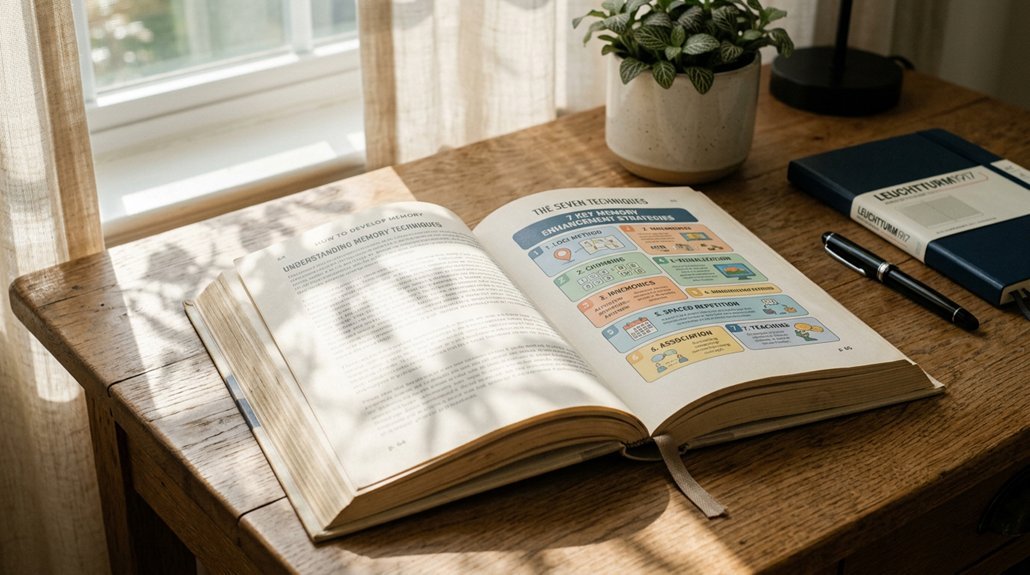


You don’t need a “photographic memory” to remember what matters. You just need the right techniques working for you.
Chunking breaks big ideas into bite-sized pieces your brain can actually hold. Linking new facts to stuff you already know builds instant hooks for later.
A memory palace turns boring lists into mental walks through familiar places. Handwriting beats typing for retention; your brain works harder, so the memory sticks deeper.
Testing yourself beats rereading every time. Spaced repetition fights forgetting without wasting hours. And sleep? That’s when your brain locks it all in.
Each method has limits. Chunking won’t help with abstract concepts alone. Memory palaces take setup. But combined, they cover most learning situations you’ll face.
The real question isn’t whether these work. It’s which one you’ll start with first, and what happens when you stack them together.
Chunk Information to Protect Your Working Memory
Since your working memory can only hold a few pieces of information at once, you’ll hit a wall fast when you’re trying to cram in too much at once. That’s where chunking saves you.
How Chunking Works
Chunking breaks large material into smaller, logical units. Each unit fits your working memory limits, making it easier to encode into Long Term Memory. You’ll remember more with less effort.
Try These Chunking Methods:
- Use structured outlines: main ideas, subpoints, then details. This reduces mental overload and supports memory recall later.
- Group numbers or facts: a phone number becomes 130-555-1212, not 1305551212.
- Make each chunk meaningful through active processing. Connect chunks to what you already know.
Lock It In
Rehearse each chunk with spaced practice and quick self-tests. Your Memory strengthens each time you retrieve it.
Recommended Products


Link New Ideas to What You Already Know

You already know how to remember your best friend’s face or your favorite song, so why not use that same power for new facts? When you actively weave fresh ideas into what you already understand, you build a web of connections that makes recall much easier. Start by outlining the topic into clear chunks, then use vivid images, sounds, or even smells to tie new details to your existing memories.
Recommended Products

Develop Handwriting Skills with Complete Magic Grooved Writing Practice for Kids. Preschool learning toys packed with activities that engage hands-on learners, this 5-book set includes 2 magic pens, 10 disappearing ink refills, 2 soft pencil grips, and a sticker sheet. Ideal for screen-free entertainment and fine motor skill growth. Fun, learning toys for 4 year old for home use or classrooms, supporting early learning and creative self-expression.

✏️ Magic Grooved Writing Practice Set for Early Learners - This 6-book handwriting practice set includes Alphabet, Numbers, Math, Drawing, Shapes, and Sight Words workbooks. The deep groove paths guide children to trace correctly, helping build handwriting skills, stroke memory, and early learning confidence through repeated practice.
Based Connections Strengthen Recall
Your brain rarely holds onto isolated facts. You need to weave new ideas into what you already know, creating more “nodes” that help with retaining information.
Build Stronger Memory Links
Try these memorization techniques:
- Method of loci: Picture a familiar place, like your home. “Place” items in specific spots and walk through mentally to retrieve them. It’s a powerful mnemonic device.
- Peg systems: Link items to numbers 1–10 for easy sequence recall.
- Context cues: Study with the same music or sounds you’ll have during testing. Matching conditions boosts recall.
These strategies work with the spacing effect, helping you lock in knowledge through meaningful connections rather than cramming. You’ll remember more when facts link to sights, sounds, and experiences you already have.
Elaboration Builds Semantic Networks
Memory hooks work best when they’re tied to something deeper than a location or number. That’s where elaboration comes in. You’re actively weaving new ideas into your existing knowledge, building a rich semantic network in your brain.
Instead of memorizing isolated facts, you’re creating multiple pathways to the same information. This boosts memory performance far beyond simple repetition. Your prefrontal cortex compares new details against what you already know, strengthening connections each time you apply an idea.
Try these elaboration strategies:
- Explain concepts in your own words
- Link new ideas to personal experiences
- Compare unfamiliar topics to familiar ones
- Ask yourself “how” and “why” questions
- Connect facts across different subjects
Unlike basic mnemonic devices, elaboration builds lasting understanding. You’re not just storing data, you’re growing an interconnected web of knowledge that makes recall natural and reliable.
Build a Memory Palace for Ordered Recall

You’ll start by picking a familiar location you know inside and out, like your home or daily route to school, since that mental map becomes your foundation. Next, you’ll create a fixed mental journey through that space, moving room by room or landmark by landmark in the same order every time. This spatial mapping technique, called the method of loci, lets you park information at specific stops along your path so you can walk it again later and pick up each item in perfect sequence.
Recommended Products

PREP YOUR CHILD TO SCORE HIGHER ON THE SCAT: Build verbal and math skills for both sections of the Elementary SCAT test. Cards also include our experts’ best test-taking...
Spatial Mapping Basics
Often, the easiest way to remember a long list in order is to stop fighting your brain and start using space itself. You’ll use the Method of Loci, one of the oldest memory techniques that still works today. Pick a familiar place, like your home. Then mentally “place” each piece of information in a specific spot inside it. To recall, you simply walk through those rooms in your mind.
Here’s how to build your first palace:
- Choose a familiar location you know well
- Create a clear path from start to finish
- Make each spot vivid with sensory details
- Start small with 5 to 10 locations
- Practice retrieval before checking your list
These steps will Improve Memory through spatial anchors that your brain naturally holds onto.
Mental Journey Creation
How do you turn a familiar walk into a powerful memory tool? You build a memory palace using the method of loci, one of the most reliable techniques for boosting Memory Retention.
Here’s how you create your mental journey:
- Pick stop points along a familiar route, like room-by-room through your home
- Place each item you need to remember at a specific stop, in the exact order you’ll need to recall it later
- Make every image vivid and sensory, adding colors, sounds, or smells so your brain latches on
This powerful tool works because the journey itself becomes your order cue. You won’t scramble for sequence; you’ll simply walk through mentally.
Practice short retrieval runs instead of rereading. Revisit the same route consistently to strengthen those memory links and reduce blanking when it counts.
Familiar Location Selection
Because your memory palace lives or dies on the location you pick, start with a place you know inside out. Memory champions swear by this familiar location selection trick: it turns ordinary spaces into powerful memory storage systems.
You’ll mentally walk through rooms in a fixed order, letting each spot hold one piece of information. This beats scrambling through long strings of random data. To improve your memory even more, try these ideas:
- Pick your childhood home or daily route
- Assign one vivid image per spot
- Chunk big lists into room-sized groups
- Add sensory details to each stop
- Practice your route with spaced repetition
Keep your palace simple, personal, and well-traveled. The better you know it, the faster you’ll find what you stored.
Write Notes by Hand to Remember More
Grab a pen and paper the next time you need to remember something important. Writing by hand can help you remember far more than typing ever will.
Research from Princeton and UCLA shows that handwriting beats typing for both factual recall and deeper understanding. When you type, you’re likely to transcribe mindlessly. But when you write by hand, you slow down and think harder about what matters. This extra effort pushes your brain to select, synthesize, and structure information into meaningful chunks.
That process strengthens your ability to retain what you learn. To memorize information effectively, focus on three parts: capturing key ideas, organizing them clearly, and reviewing actively later. Your handwritten notes become a bridge from short-term sensory input to long-term storage. Choose ink and paper first, then switch to flashcards or summaries for review.
Test Yourself Instead of Rereading
Why keep rereading the same page when your brain learns better by pulling information out? When you test yourself, you’re not just checking what you know; you’re actually building stronger memories. Research by Roediger and Karpicke shows that students who read once and tested three times retained 62% of material, compared to only 39% for those who reread four times. That’s a huge difference.
Here’s how to put this into practice:
- Quiz yourself with flashcards instead of highlighting
- Guess answers before reading to prime your brain function
- Turn notes into questions that require trying to remember
- Use short, repeated sessions rather than cramming
- Treat wrong answers as learning tools, not failures
Active recall moves information from short-term memory into lasting storage. You’ll have a better chance of remembering when it counts.
Recommended Products

📗【Toddler Writing Practice】:This magic practice copybook set includes 1 addition and subtraction, 1 number, 1 fun picture, 1 letter, 1 pen, 1 handle and 10 refills. The kindergarten workbook is compact and lightweight, perfect for children to practice handwriting anytime, anywhere—at school, while traveling, or during play.(5.1inches x 7.4 inches)


Satisfaction Ensured
Space Your Reviews to Stop Forgetting
You can almost always improve your memory by spreading out your study sessions instead of cramming everything into one long block. This approach, called spaced practice, works because your brain forgets quickly without reinforcement. In fact, you can lose about 90% of what you learned within a month if you don’t revisit it.
Spaced practice beats cramming every time—your brain needs reinforcement, not marathons, to hold onto what you learn.
Tips to Improve Your Timing****
- Space your reviews so the gap is roughly 10–20% of the time until your test.
- Test yourself between sessions using active recall to strengthen memories before they fade.
- Keep your study setting similar to where you’ll take the test; mismatches can cause blanking even when you studied hard.
Stop trying to cram. Each well-timed review flattens memory decline and can boost retention by up to 300% compared with poor timing. You’ll retain more with less stress.
Sleep on It: How Consolidation Locks In Learning
While spaced practice helps you encode information, your brain still needs time to lock those memories in place. Sleep does exactly that. Your human brain doesn’t just rest during the night, it actively strengthens what you’ve learned. When you get quality sleep, you move new information into long-term memory. Deep sleep creates a memory that’s stable and ready to recall.
Aim for 7–9 hours if you’re 18–25, especially after tough study sessions. Here’s how to support your brain:
- Exercise regularly to deepen sleep quality
- Practice mindfulness or meditation to lower stress
- Skip alcohol close to bedtime
- Cut caffeine after noon
- Keep a consistent sleep schedule
Without enough sleep, you lose focus and your consolidation suffers. Prioritize rest, and you’ll lock in learning.

I am Đinh Ai Nguyễn, a content writer at SoftAuraHome.com. For me, home is more than just a place to live. It is where we recover from long days, hold our quiet moments, and create the atmosphere that shapes how we feel. That belief is one of the biggest reasons I wanted to be part of this blog. I started writing about home decor because I have always been drawn to spaces that feel soft, peaceful, and emotionally grounding. I believe a calm room can do more than look beautiful. It can bring comfort, restore energy, and help people feel more connected to themselves and the life they are building. Through Soft Aura Home, I want to share ideas that are not only visually inspiring, but also meaningful in everyday life. With experience in SEO writing and niche content publishing, I understand how to create articles that are clear, useful, and easy to discover. But beyond strategy, I care deeply about how a piece of content makes someone feel. Every article I write is created with the hope of helping readers shape homes that feel gentle, personal, and full of quiet warmth.
Follow on Facebook